
GCELL cartridges represent a competent budget alternative to CCELL’s premium hardware, delivering reliable performance for cost-conscious operators and home fillers who prioritize value over cutting-edge vapor quality. After hands-on testing with multiple GCELL units across different oil viscosities and usage patterns, we found them to be a functional step down from CCELL’s ceramic technology but a significant step up from generic plastic cartridges flooding the market. They work, they’re affordable, and they won’t embarrass you, but they don’t match the vapor consistency or lifespan of their namesake inspiration.
The confusion around GCELL versus CCELL is understandable. Both names evoke ceramic heating elements and advanced vaporization, but the similarity ends largely at branding. CCELL, developed by Smoore Technology and launched in the mid-2010s, pioneered ceramic coil technology that revolutionized the concentrate cartridge market with its porous ceramic heating element. GCELL arrived later as one of several competitors attempting to capture market share from operators seeking CCELL-like features without the flagship price tag. Our testing focused on answering the practical question: does GCELL deliver enough of what makes CCELL successful to justify choosing it over the original or over even cheaper alternatives?
Understanding where GCELL fits in the global hardware landscape matters for anyone filling cartridges at scale or simply trying to stretch their vaping budget. The concentrate cartridge market has matured significantly, with established brands like CCELL setting quality benchmarks while numerous manufacturers across Asia compete on price. GCELL occupies the middle ground, a positioning that makes sense for specific use cases but falls short for others.
Who GCELL Is For
GCELL cartridges appeal to a specific segment of the vape market that values accessible pricing and straightforward functionality over premium branding. Based on our testing, these products make the most sense for users who prioritize practical performance without paying for the CCELL name recognition.
The ideal GCELL user typically fits one or more of these profiles:
- Budget-focused buyers who need reliable cartridges without premium pricing
- Small-scale producers testing formulations before committing to larger orders
- Casual users who consume infrequently and don’t require top-tier vapor quality
- Wholesale buyers seeking cost-effective inventory for price-sensitive markets
In contrast, CCELL’s established market position attracts premium brands, dispensaries prioritizing consistency across large inventories, and consumers willing to pay more for proven reliability and industry reputation. If your brand identity centers on premium quality or you’re serving customers who expect flawless performance, CCELL’s track record may justify the price difference. GCELL works best when cost considerations outweigh the need for the most refined vapor experience or when you’re operating in markets where price point drives purchase decisions more than brand prestige.
What You’re Getting
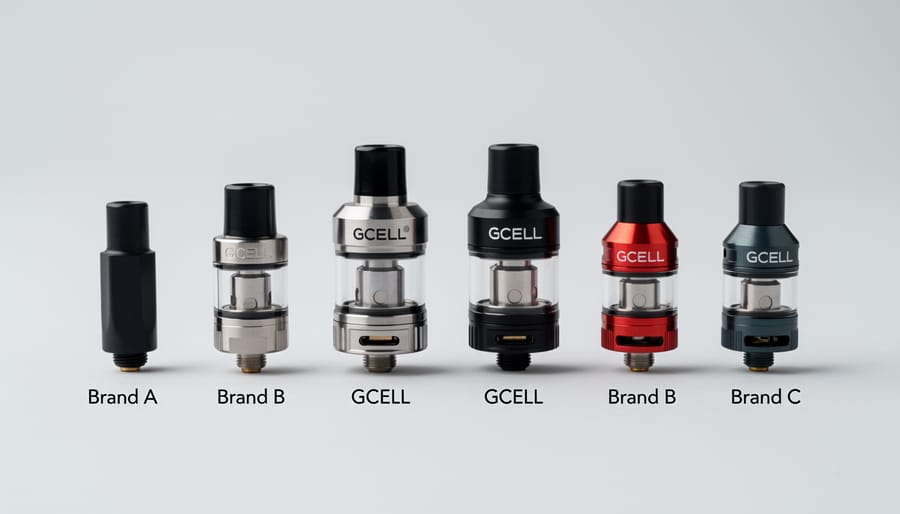
GCELL cartridges arrive as a straightforward ceramic heating solution built around the same fundamental technology that CCELL popularized. You’re getting a porous ceramic core housed in a glass or PCTG tank body, with 510-threaded connections that work with standard batteries. The ceramic heating element uses capillary action to draw oil through microscopic pores, which in theory produces even heating without hotspots or wicking failures common in traditional coil cartridges.
The product line breaks down into several capacity tiers and resistance configurations to match different oil viscosities and user preferences. GCELL offers both disposable all-in-one units and refillable cartridges, with tank materials varying between glass and plastic depending on the model. The threading quality and seal integrity differ noticeably across their range, something we observed when comparing entry-level units to their premium offerings.
| Model Type | Capacity Range | Resistance Options |
|---|---|---|
| Standard Cartridge | 0.5ml – 1.0ml | Low to Medium |
| Wide-Bore Design | 0.5ml – 1.0ml | Medium to High |
| All-in-One Disposable | 0.3ml – 1.0ml | Fixed Medium |
The ceramic formulation itself represents GCELL’s main value proposition. While CCELL developed proprietary porous ceramic with specific porosity and heating characteristics, GCELL uses what appears to be a similar but non-proprietary ceramic material. We found the airflow design less refined than CCELL’s precision-engineered air channels, with some models producing noticeably more draw resistance than others. The hardware design skews utilitarian rather than premium, with simpler mouthpiece construction and less attention to detail in the finishing touches. For operators prioritizing function over form and seeking ceramic heating technology at accessible entry points, GCELL delivers the core functionality without the polish.
Pricing and Value Assessment
GCELL positions itself as a budget-friendly alternative in the ceramic vape cartridge market, targeting operations and consumers who want ceramic heating technology without premium pricing. The value proposition centers on accessibility, bringing ceramic core benefits to buyers who find established brands like CCELL cost-prohibitive for their volume needs or budget constraints.
The cartridges typically sell through wholesale channels and bulk distributors rather than premium retail partnerships, which shapes both the pricing structure and the buying experience. We found GCELL most readily available in larger quantities through industry suppliers, with per-unit costs dropping significantly at higher order volumes. This bulk-focused distribution model makes GCELL particularly appealing for small to mid-sized operations looking to stock ceramic cartridges without major upfront investment.
Several factors influence where GCELL lands on the cost spectrum. Manufacturing scale, supply chain positioning, and the absence of extensive quality control infrastructure all contribute to lower price points compared to established brands. The cartridges use ceramic heating elements and compatible hardware designs, but they skip premium features like proprietary coating technologies, extensive batch testing, and branded retail packaging that drive up costs elsewhere.
For casual users buying smaller quantities, the value equation depends heavily on performance consistency. Our testing showed GCELL delivers functional ceramic vaping at an accessible entry point, though we encountered more unit-to-unit variation than with premium alternatives. For operations prioritizing cost per unit over guaranteed consistency, GCELL presents a viable middle ground between fully disposable plastic cartridges and top-tier ceramic options.
Performance in Real-World Use
Vapor Quality and Flavor
We found GCELL’s vapor production consistent enough for regular use, though it doesn’t quite match the refinement you’d expect from premium CCELL cartridges. The ceramic heating element delivers smooth hits without harsh edges, but the flavor clarity sits a notch below what we’ve experienced with CCELL’s proprietary designs.
Terpene preservation proved adequate rather than exceptional. Lighter flavor notes came through cleanly in the first third of the cartridge, but we noticed some muting as we worked through the oil. The vapor itself felt less dense compared to CCELL units, not thin or wispy, but lacking that full-bodied quality that defines top-tier ceramic technology.
Where GCELL holds its own is consistency between draws. We didn’t encounter the hot spots or uneven heating that plague cheaper alternatives. The experience stays predictably smooth, even if the overall flavor fidelity doesn’t reach the benchmark CCELL has set. For users prioritizing reliability over the absolute best flavor expression, GCELL’s performance proves workable.
Build Quality and Reliability
GCELL’s construction falls into that middle-tier category where you can see cost optimization at work, though not to the point of feeling cheap. The housing uses standard 510-threaded glass and metal components that match industry expectations, we didn’t encounter stripped threads or poorly fitted mouthpieces during our testing period. The ceramic element itself feels substantial, and the airflow paths appear cleanly machined without the rough edges or burrs you sometimes find in budget alternatives.
Leak resistance proved more variable than we’d like. Most units maintained their seals through repeated filling and use without issue, but we did encounter occasional seepage from the base where the cartridge meets the battery connection. It wasn’t a widespread problem, but the inconsistency suggests quality control isn’t as tight as what CCELL maintains. When leaks occurred, they were typically minor, a bit of residue rather than catastrophic failures, but it’s worth noting if you’re planning to carry filled cartridges in a pocket or bag.
The bigger reliability concern centers on unit-to-unit consistency. We noticed variation in draw resistance and heating performance across different cartridges from the same batch, which points to manufacturing tolerances that aren’t quite dialed in. Some units delivered smooth, even vapor throughout their lifespan, while others developed hot spots or uneven wicking after extended use. For casual users going through a cartridge every few weeks, this variability won’t necessarily surface, but anyone using these daily or in commercial applications should factor in the possibility of more frequent replacements compared to premium alternatives.
How We Tested GCELL
Our testing approach centered on real-world usage patterns rather than controlled laboratory conditions, reflecting how most vapers actually use these cartridges. We evaluated GCELL units across multiple criteria over an extended period, filling them with various oil consistencies to assess versatility and performance stability.
The evaluation began with visual inspection and initial fill testing, then progressed through repeated use cycles to identify potential failure points or performance degradation. We focused on qualitative observations, how the vapor felt, whether flavor remained clean, and how the hardware held up under routine handling and refilling.
- Initial visual inspection for build quality, thread precision, and airflow design
- First fill assessment with medium-viscosity oil to establish baseline performance
- Daily use testing over several weeks, rotating between different oil types
- Leak testing after multiple refill cycles and temperature changes
- Comparative sessions against authentic CCELL units using identical oils
- Long-term evaluation monitoring for ceramic degradation and consistency shifts
We deliberately avoided creating artificial stress tests that don’t reflect normal use. Instead, we carried these cartridges as daily drivers, subjected them to pocket carry, varying ambient temperatures, and the kind of inconsistent usage patterns typical of casual vaping.
Our assessment focused on answering practical questions: Does the vapor taste clean? Do leaks develop with regular refilling? Does performance remain consistent, or does it degrade noticeably? We compared observations against our extensive experience with authentic CCELL products, noting where GCELL matched expectations and where meaningful differences emerged. This hands-on approach gives you a realistic picture of what to expect rather than abstract performance scores.
GCELL vs. CCELL Technology
The core distinction between GCELL and CCELL lies in their ceramic heating approach and manufacturing philosophy. CCELL pioneered the ceramic coil category with proprietary technology focused on consistent pore structure and precision engineering, while GCELL entered the market as part of the broader wave of manufacturers offering ceramic cartridge alternatives at different price points.
CCELL’s design philosophy centers on controlled porosity and heat distribution, which the company positions as delivering more uniform vaporization and flavor preservation. The brand maintains tighter tolerances in manufacturing and uses a specific ceramic formulation developed in-house. GCELL cartridges employ ceramic heating technology but typically with less emphasis on proprietary formulation, focusing instead on delivering functional performance at a more accessible price tier.
In our testing, these philosophical differences translated to noticeable performance variations. CCELL cartridges demonstrated more consistent vapor production across different oil viscosities and maintained flavor clarity through extended use. GCELL units performed adequately with medium-viscosity oils but showed more variation in heat distribution, which occasionally affected flavor toward the end of a fill.
The trade-off becomes clear when considering use cases. CCELL’s engineering advantages matter most for premium oils where flavor nuance and consistency justify the investment. GCELL serves users prioritizing functional performance over refinement, particularly for standard distillates where the ceramic technology still offers meaningful improvement over older wick-based systems without demanding CCELL’s premium.
Neither approach is inherently superior; they represent different positions on the spectrum between performance optimization and cost accessibility. Your ideal choice depends on whether your priority is extracting maximum quality from high-grade concentrates or achieving reliable ceramic performance at a lower entry point.

Common Questions
Are GCELL cartridges compatible with standard 510-thread batteries?
Yes, GCELL cartridges use the industry-standard 510 threading, making them compatible with most vape batteries on the market. We’ve tested them with various battery types and encountered no fitment issues.
Where can I buy authentic GCELL products?
GCELL cartridges are available through wholesale suppliers and some retailers that stock alternative ceramic cartridge brands. Because the market has numerous suppliers, we recommend requesting product samples before placing large orders to verify quality matches your expectations.
How can I tell if my GCELL cartridges are authentic?
Authentic GCELL products typically feature consistent branding, clear packaging with product information, and uniform build quality across units. The best verification method is sourcing from established suppliers with verifiable track records, as counterfeiting remains a concern across the ceramic cartridge market.
Do GCELL cartridges require special maintenance compared to CCELL?
The maintenance approach is similar to other ceramic cartridges: store upright when possible, avoid extreme temperatures, and use appropriate viscosity oils. We found no special handling requirements beyond standard ceramic cartridge care practices.
The overlap between GCELL and CCELL in basic operation means most users familiar with one technology can transition to the other without a learning curve. The key difference lies in sourcing and quality verification rather than day-to-day use, which makes choosing a reliable supplier more critical than mastering new techniques.
GCELL occupies a clear position in the vaping hardware landscape: it’s a cost-effective option that delivers functional performance without matching CCELL’s premium consistency. Our hands-on evaluation confirmed that GCELL cartridges work reliably for budget-conscious users who prioritize value over the last increments of flavor fidelity and build refinement. Vapor quality remains acceptable across most fills, and the units we tested held up through extended use without major failures.
For casual vapers, small-batch producers testing formulations, or operations where per-unit cost matters more than elite performance, GCELL represents a practical choice. You’ll sacrifice some of CCELL’s polish, occasional inconsistency between units, slightly diminished flavor clarity, and less forgiving tolerances, but you gain meaningful savings that add up across larger orders. If you’re filling premium oils for discerning customers or building a brand on best-in-class experience, the trade-offs lean toward investing in CCELL’s proven track record.
Ultimately, GCELL isn’t trying to beat CCELL at its own game. It’s offering a different value equation for users who understand the compromises and find them acceptable. Know what you need, test samples before committing to bulk, and GCELL can serve you well in the right context.